About
Learn who created these pink noise audio tracks, why they were developed, and how they are designed for accurate, real-world audio use.
Learn who created these pink noise audio tracks, why they were developed, and how they are designed for accurate, real-world audio use.
All audio tracks are created by Milan Lipowski and released under the artist name Milan Wilkinson, registered with Broadcast Music, Inc. (BMI).
Milan has spent more than 30 years working with both analog and digital audio. His expertise comes from decades of hands-on work, continuous learning, and practical experimentation rather than formal engineering roles.
This includes improving and modifying audio equipment, recapping and repairing amplifiers and preamplifiers, designing and building custom PCB boards, and creating specialized cables and USB audio filters for cleaner signal paths. He also works on calibration and system setup, including bias adjustment and stability optimisation across a wide range of audio systems.
In recent years, his focus has expanded into digital music production, post-production, and detailed audio editing.
This combination of practical hardware experience and modern digital workflows forms the foundation behind the pink noise tracks offered here, with a focus on accuracy, consistency, and real-world usability.
A reliable pink noise signal was required for speaker and headphone warm-up, with a preference for using a real audio track rather than a generator.
A pre-rendered track allows the signal to pass through the entire playback chain, making it more representative of real-world use. Over time, pink noise was also used for amplifier bias adjustment, system measurements, and DAC testing, where a consistent and predictable reference signal became essential.
Many available tracks online were found to be inconsistent, limited in quality, or not designed for technical use. High-resolution (Hi-Res) files were often missing, and level consistency was not always reliable.
As a result, Milan began creating his own tracks, focusing on high-resolution sources, stable levels, and repeatable behaviour. The goal was simple: a signal that can be trusted for calibration, testing, and everyday use.
What started as a personal solution gradually developed into a broader project, including dedicated versions for relaxation and sleep, built with the same attention to quality and consistent playback.
Pink noise is widely used as a reliable reference signal across audio systems, from calibration and tuning to analysis and everyday playback.
Provides a consistent reference signal for setting accurate and repeatable playback levels. It helps ensure systems remain balanced without bias toward specific frequencies.
Helps identify reflections, standing waves, and frequency imbalances in real listening conditions. This allows more precise adjustments to speaker placement and equalisation.
Used to evaluate frequency response, phase alignment, and the effectiveness of room treatment. Its even distribution across octaves makes it suitable for broad-spectrum analysis.
A pre-rendered track ensures consistent playback across the full audio chain. This reduces variation introduced by software generators and better reflects actual listening conditions.
Even energy distribution allows all drivers to stabilise without unnecessary stress. It is commonly used to prepare systems before critical listening or measurement.
Pink noise is used in music production for initial level balancing. By setting elements just above the noise floor, a consistent starting point is established before detailed mixing.
Also used as a stable background signal for relaxation and uninterrupted playback. Its steady character makes it suitable for long listening sessions without sudden changes.
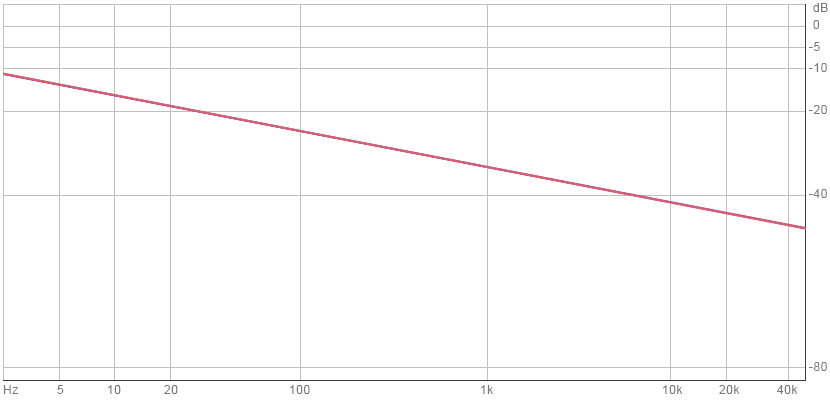
Pink noise is acoustic energy distributed evenly per octave across the entire audio spectrum. This means each frequency band carries the same amount of energy, but because human hearing is logarithmic, pink noise sounds deeper and warmer compared to white noise.
As shown in the graph, lower frequencies in pink noise carry more power, creating the bass rumble that can be heard. Higher frequencies gradually roll off, making pink noise especially useful for testing speakers, calibrating rooms, and balancing audio systems in real-world listening conditions.